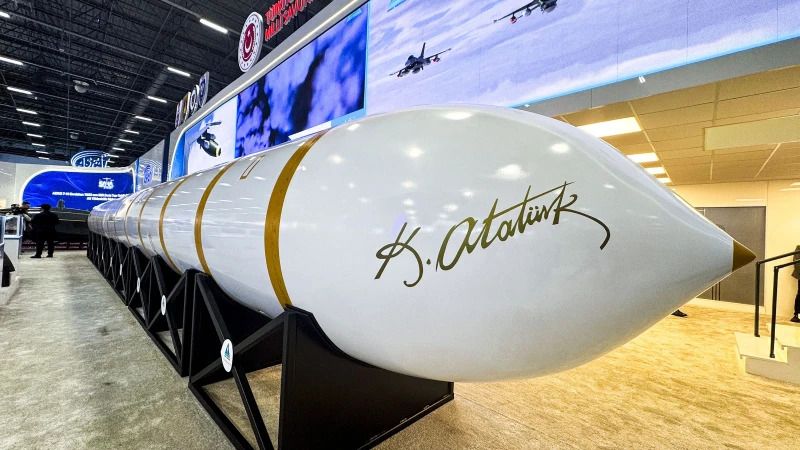
The emergence of the YILDIRIMHAN missile system marks a definitive turning point in the annals of Turkish history, representing far more than a mere addition to a military inventory. It signifies the end of an era where high-level ballistic and intercontinental technologies were the exclusive domain of a handful of global superpowers. For decades, the ability to project power across continents and master the complexities of long-range precision was a monopoly held tightly by a few Western nations and Russia. This concentration of advanced weaponry created a lopsided global hierarchy where most nations remained perpetually vulnerable. However, the successful development and introduction of YILDIRIMHAN demonstrate that this monopoly is finally shattering. The democratization of high-end defense technology is a burgeoning reality, and Türkiye has now firmly established its place within that elite circle, proving that strategic autonomy is no longer a distant dream but an accomplished fact.
To understand the weight of this achievement, one must look at the staggering technical prowess embodied by this system. YILDIRIMHAN is not merely an incremental upgrade from its predecessors, like BORA or TAYFUN; it is a leap into the future of kinetic physics and aerospace engineering. Capable of reaching velocities between Mach 9 and Mach 25, the missile moves at speeds that render traditional interception and air defense systems largely obsolete. By the time a radar system identifies such a threat, the window for reaction has already closed. This capability is bolstered by its sophisticated propulsion system, utilizing four rocket engines fueled by liquid nitrogen tetroxide, a choice that provides the immense thrust necessary to carry a massive 3,000-kilogram payload. The sheer volume of explosives it can deliver across intercontinental distances places it in a category of deterrents that commands immediate respect on the international stage.
However, the discussion surrounding such a formidable weapon often falls into the trap of warmongering rhetoric, which misses the fundamental strategic purpose of its existence. It is a common misconception that the production of an intercontinental missile is an invitation to conflict. On the contrary, YILDIRIMHAN is designed precisely to ensure that war never happens. In the realm of international relations, true peace is rarely maintained by goodwill alone; it is maintained by a balance of power where the cost of aggression becomes unacceptably high. When a nation possesses the ability to strike back with overwhelming force, the incentive for any external power to initiate a conflict vanishes. Therefore, this missile serves as a guardian of stability, an invisible shield that reinforces the sovereignty of the state by making the price of violation too steep for any rational actor to pay.
This perspective is supported by a sober look at global military history. Currently, only about nine countries in the world possess such advanced long-range missile capabilities. Despite the destructive potential of these weapons, they are almost never used in active combat. A rare exception occurred during the ongoing conflict between Russia and Ukraine, where such technology was deployed. Yet, even in that high-stakes environment, the use of a strategic missile did not fundamentally alter the ultimate fate or the eventual outcome of the war. This observation leads to an inescapable conclusion: these weapons are not practical tools for winning battles on a day-to-day basis. Their primary value is psychological and strategic. They exist to prevent the escalation of local skirmishes into total wars and to ensure that the territorial integrity of the possessing nation remains unquestioned. To claim that YILDIRIMHAN was built for the purpose of active warfare would be a misunderstanding of modern military doctrine; it was built to silence the drums of war before they even begin to beat.
The most profound evidence of this intent can be found in the symbolic details of the missile itself. In a gesture that bridges the gap between lethal force and national philosophy, the warhead of the YILDIRIMHAN carries the signature of Mustafa Kemal Atatürk, accompanied by his timeless motto: "Peace at Home, Peace in the World." To place a message of peace on a weapon of such devastating potential might seem like a paradox to the casual observer, but it is actually a masterful stroke of strategic communication. It serves as a constant reminder that Türkiye’s strength is rooted in a defensive posture. The signature of the founding father acts as a moral compass, signaling to the world that while the nation now possesses the claws of a lion, its heart remains dedicated to the preservation of harmony. It tells every potential adversary that Türkiye is prepared for the worst so that its people can enjoy the best of a peaceful life.
Ultimately, the YILDIRIMHAN represents the maturity of a nation that has learned to navigate the harsh realities of the twenty-first century. By breaking the old monopolies of power, Türkiye has not only secured its own borders but has also contributed to a more multipolar and balanced world. This missile is a testament to human ingenuity and a commitment to self-reliance. It stands as a silent sentinel, ensuring that the progress and prosperity of the country are never held hostage by external threats. By enshrining Atatürk’s vision of global peace on its most powerful instrument of defense, Türkiye has sent a clear and dignified message: we seek no one’s land, we threaten no one’s security, but we possess the means to ensure that our own peace remains undisturbed for generations to come. This is the true legacy of YILDIRIMHAN—a weapon born of necessity, dedicated to the preservation of life and the prevention of war.

