The nearly 30-year occupation of Azerbaijan’s territories by Armenia was not limited to the forceful alteration of the military and political status quo, but was also accompanied by a deliberate and ideologically driven policy of cultural destruction. Armenian occupiers not only destroyed material and cultural heritage during this period, but also committed inhumane acts such as the desecration of religious monuments, the erasure of historical memory, and the elimination of traces reflecting national identity. This policy not only contradicts the fundamental principles of international humanitarian law but can also be assessed, in essence, as a pattern of behavior bearing elements of cultural genocide. Following the end of the occupation and the restoration of Azerbaijan’s sovereign control over these territories, the reality that had been concealed for many years has fully come to light, with large-scale destruction, acts of vandalism, and the deliberate deformation of historical heritage now confirmed by undeniable evidence.
Damage to cultural heritage in Azerbaijan’s territories occupied by Armenia: Facts and figures
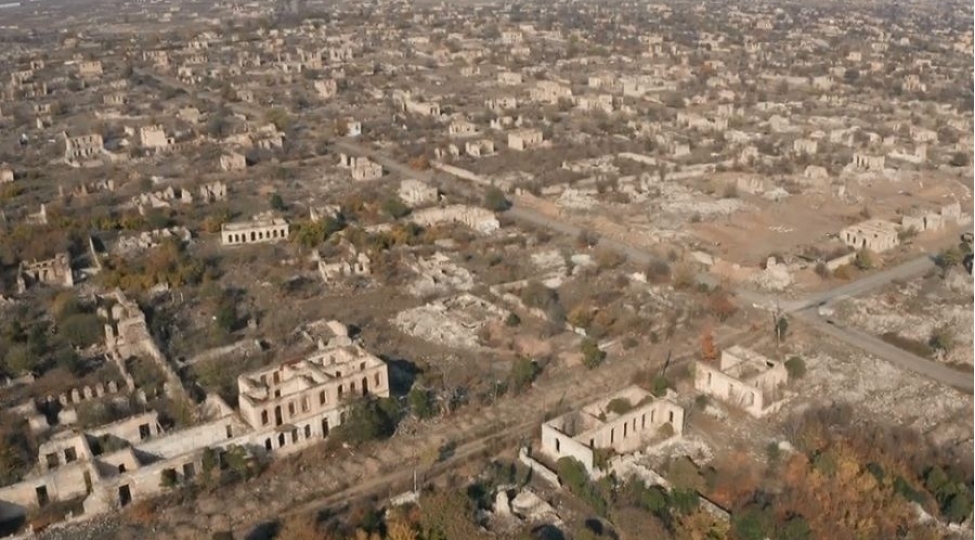 Aghdam city
The acts of vandalism committed by Armenia while occupying 20 percent of Azerbaijan’s territories are also revealed by figures.
During the occupation period, more than 700 historical monuments, 22 museums, including 100,000 museum exhibits, 927 libraries, 58 archaeological settlement sites, 26 fortresses and fortress walls, as well as other cultural heritage monuments, were appropriated, destroyed, and looted by Armenia.
Out of 67 mosques, 65 were completely destroyed, while two were partially destroyed and used for keeping animals.
The 6th-century Alban Aghoghlan Monastery and the 14th-century Malik Ajdar mausoleum in Lachin; the 4th-century Alban Amaras Monastery and numerous Alban temples in Khojavend; the 18th-century Askeran Fortress, 14th-century mausoleums, and several medieval Alban temples in Khojaly; as well as the 6th-century Alban Saint Jacob Monastery, the 13th-century Alban Khatiravang Monastery, and the 13th–14th-century Lekh Fortress in Kalbajar have been appropriated and looted by Armenians.
Also among them are the 5th–8th-century Alban monastery in Gazakh; the 13th–14th-century Mirali mausoleum and the 17th-century caravanserai in Fuzuli; a 14th-century mausoleum in Zangilan; a 17th-century mosque complex in Jabrayil; the Upper and Lower Govhar Agha Mosques, caravanserais, and residential houses in Shusha; and a 19th-century mosque in Aghdam.
In addition, archaeological sites such as Garakopektepe, Khantepe, Guneshtepe, Uzuntepe, Meynatepe, and Zergartepe in Fuzuli; Neolithic and Bronze Age settlements and sites such as Chiragtepe and Garaghajy, as well as the medieval settlement of Gavgala in Aghdam; Bronze Age sites including Imangazantepe and Gishlag barrows in Jabrayil; Bronze Age rock carvings in Kalbajar; a stone-box necropolis from the Bronze and Iron Ages in Khojaly; a Bronze Age necropolis and settlement in Sadarak; barrows from the Bronze and Iron Ages in Lachin; and stone-box graves from the Bronze and Iron Ages, as well as a Stone Age cave in Shusha, have also been appropriated and looted.
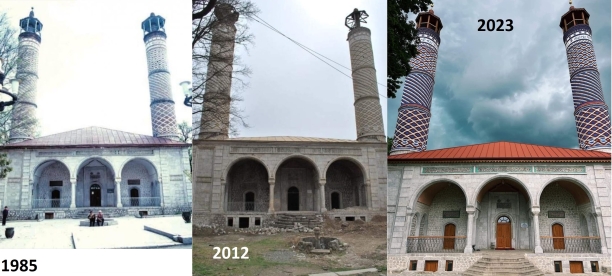 Upper Govhar Agha Mosque, Shusha
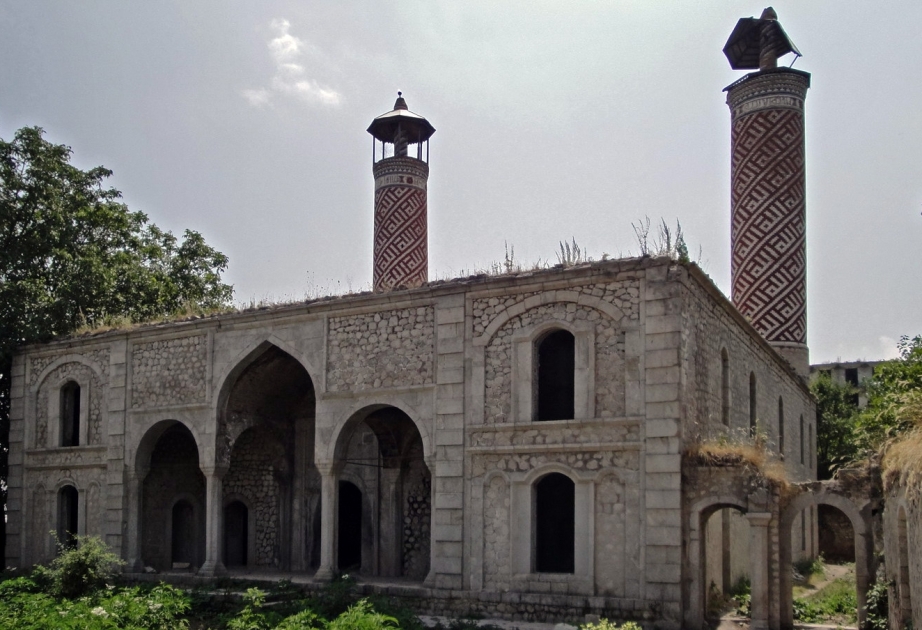 Lower Govhar Agha Mosque, Shusha
Among the monuments of world importance in the territories of Azerbaijan occupied by Armenia are the 11-span and 15-span Khudafarin bridges of the Bronze Age and the Niftali kurgans in Jabrayil, the medieval Albanian Gandzasar and Khudavang monasteries in Kalbajar, the 14th-century Gutlu Musa oglu Mausoleum in Aghdam, as well as the Bronze Age Uzarliktepe settlement, the Azikh and Taghlar caves of the Paleolithic period in Khojavend, and the kurgans of the Bronze and Iron Ages in Khojaly. These monuments also suffered from Armenian vandalism.
 14th-century Gutlu Musa oglu Mausoleum, Aghdam
Immediately after the military operations in the early 1990s, architectural monuments in Shusha, including the Upper and Lower Govhar Agha mosques and madrassas, the Vagif mausoleum, Natavan’s house and caravanserais, were destroyed, burned, and looted.
Historical, cultural and religious monuments in other territories that had been under occupation were also subjected to Armenian brutality.
In Aghdam district, the “Panah Khan’s Imarat” complex and mosques, mosques in the villages of Abdal and Gulabli, the Ugurlu bey mausoleum and the house museum of Gurban Pirimov in Aghdam district, the 14th century mausoleum in Khojaly district, mosques in the villages of Bashlibel and Otakli of Kalbajar district, ancient cemeteries in the city of Kalbajar and the villages of Moz, Keshdak and Yukhari Ayrim, mosques in Zangilan city and the villages of Giragh Mushlan, Malatkeshin, Babayli and Second Aghali of Zangilan district, ancient cemeteries in the villages of Jahangirbeyli, Babayli and Sharifan, ancient cemeteries in the villages of Gayali and Mamar of Gubadli district and a mosque in Mamar village, a mosque in Garigishlag village and an ancient cemetery in Zabukh village of Lachin district, a mosque complex in Chelebi village and an ancient cemetery in Khubyarly village of Jabrayil district, mosques in Fuzuli city and the villages of Gochehmadli, Merdinli and Gargabazar of Fuzuli district, cemeteries in the villages of Khojavend, Akhullu, Kuropatkin, Dudukchu and Salaketin of Khojavend district and an ancient cemetery in Tugh village, ancient baths in Umudlu village of Tartar district and a cemetery in Kerki village of Sadarak district were destroyed, burned and looted.
The barbaric acts of Armenians did not end there. The occupiers altered the architectural elements of monuments such as the Saatli Mosque and the Khanlig Mukhtar Caravanserai in Shusha, and replaced the inscription in Arabic script on the 19th-century Mamayi Spring in Shusha with an Armenian cross and inscriptions, substituting the Muslim Azerbaijani elements of the monuments with false Armenian symbols.
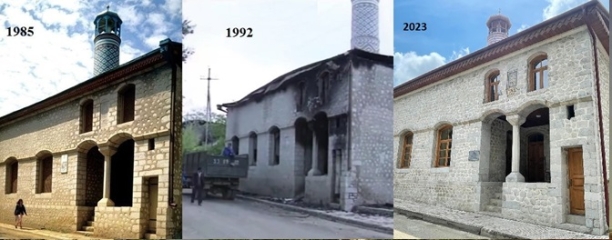 Saatli Mosque, Shusha
Armenia's vandalism policy
During the occupation period, the destruction that occurred in Karabakh and the surrounding districts is rare in modern conflict history in terms of its scale and nature. The destruction of hundreds of historical and religious monuments, the complete devastation of settlements, and the disabling of infrastructure show that this process was not spontaneous but the result of a systematic and purposeful policy.
Monitoring conducted in districts such as Aghdam, Fuzuli, Jabrayil, Zangilan and Kalbajar reveals that cities and villages were almost completely destroyed. The characterization of Aghdam as the “Hiroshima of the Caucasus” is not merely a metaphorical expression, but a political and visual description of the real scale of destruction. Such total destruction is assessed not as an ordinary consequence of war, but as an indicator of a planned policy of clearance and erasure.
Facts regarding the fate of Azerbaijani cultural heritage in the territory of Armenia demonstrate a systematic policy of destruction and alteration through the example of specific monuments.
The Shah Abbas Mosque, located in the city of Yerevan, was an important religious monument dating back to the 16th century. During the period of the Yerevan Khanate, it functioned as one of the main places of worship in the city. Historical maps and archival documents confirm its existence. During urban development changes carried out in the 20th century, the mosque was completely demolished and new constructions were built in its place.
The Sardar Mosque, located inside the Yerevan fortress, was one of the symbolic structures of the khanate period. Paintings and photographs dating back to the 19th century reflect its architectural structure. It was gradually dismantled and destroyed during the Soviet period, and today no physical trace of the monument remains.
The Haji Novruzali Mosque was another important religious monument in the city of Yerevan. This mosque functioned until the early 20th century. In the later period, it was completely demolished, new buildings were constructed in its place, and its existence as a historical monument was eliminated.
The Blue Mosque is the only Azerbaijani mosque in the city of Yerevan that has been partially preserved. During restoration works carried out on this 18th-century monument, its original architectural features were altered. Its interior was reconstructed, its function was changed, and it was adapted for use as a museum. Moreover, regrettably, today the Blue Mosque is presented as an Iranian or Persian mosque.
These facts show that in the territory of Armenia, both the complete destruction of Azerbaijani monuments and the alteration and reinterpretation of existing examples have been carried out in parallel.
Desecration of cemeteries – targeting collective memory
 Jabrayil cemetery
One of the most severe and symbolic crimes committed against cultural heritage is the systematic destruction of cemeteries. These facts are not limited to physical destruction, but are also assessed as an attack directed against the collective memory, historical continuity and identity consciousness of a people. The destruction of dozens of cemeteries, the excavation of graves and the destruction of headstones in the districts of Aghdam, Fuzuli, Zangilan, Kalbajar and Jabrayil constitute a gross violation of international humanitarian law. Such actions have been used beyond the conflict zone as a mechanism of ideological and psychological impact. The aim has not only been to erase material traces, but also to deform the memory of future generations.
Interference with religious heritage – ideological message and symbolic violence
The facts of the desecration of mosques during the occupation period carry a specific political and ideological meaning. Armenians destroyed 65 out of 67 mosques in the occupied territories, and partially destroyed two, using them as barns to keep pigs and cows. The conversion of sacred sites into places for keeping animals is not only an act of vandalism, but also an explicit humiliation and insult of religious values, and a form of symbolic violence directed at the opposing side.
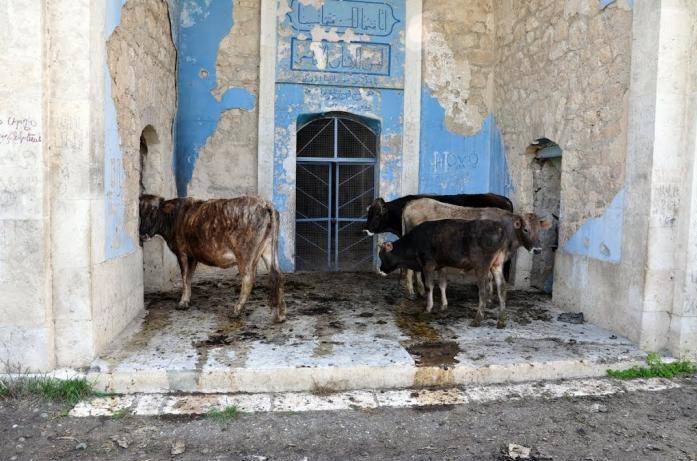 Agdam Juma Mosque
Such actions not only contradict the norms of international law, but also demonstrate that the conflict is not merely a territorial dispute, but also a confrontation built on identity and culture. Visual evidence and international observations play an important role in confirming these facts and shifting the subject of dispute from an emotional to a factual plane.
Erasure of Azerbaijani heritage in the territory of Armenia
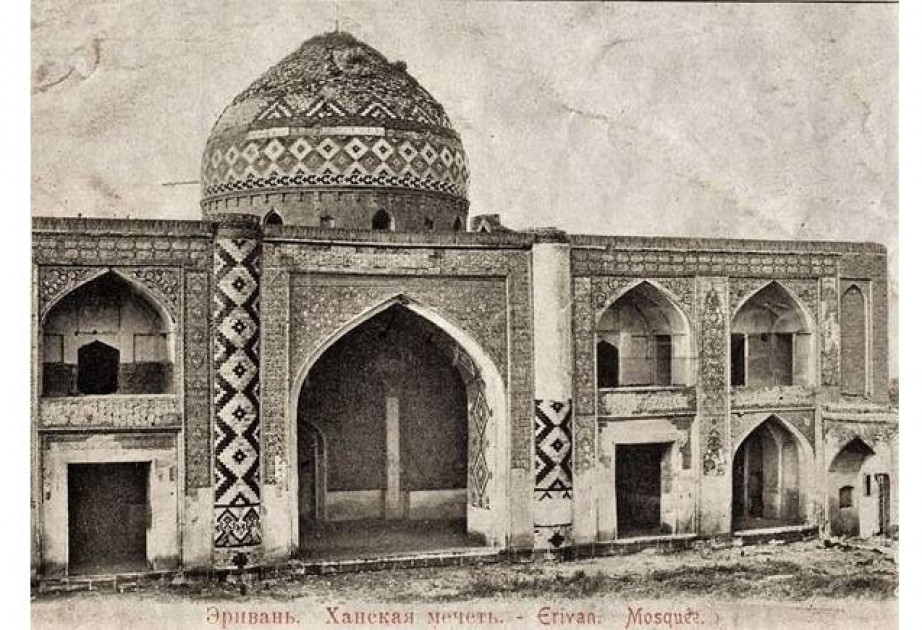 Yerevan, Khan Mosque
Acts of brutality and vandalism committed against Azerbaijan’s cultural, historical and religious monuments are not limited only to the occupied territories. The almost complete disappearance of cultural heritage belonging to the Azerbaijani people in the territory of Armenia indicates the existence of a broader policy. The destruction of mosques that once existed in the city of Yerevan or their exposure to functional changes should be assessed not as cultural transformation, but as erasure of identity.
The fact that the Blue Mosque is today presented within a different cultural framework shows that not only the physical, but also the semantic transformation of cultural heritage has been carried out. This approach is a step taken towards altering historical reality and constructing an alternative narrative.
Falsification by Armenians in relation to Albanian heritage
Against the background of the changes made to Christian monuments in Karabakh, the essence of the attitude towards cultural heritage in the region becomes more clearly visible. The erasure of inscriptions, the alteration of architectural elements and the distancing of monuments from their original identity are not random interventions, but indicators of a systematic approach. This process serves to change the historical affiliation of the monuments and present them within a different cultural context.
As historical and scholarly research shows, a significant part of the Christian monuments in Karabakh belongs to Caucasian Albania. However, the changes carried out on these temples during the occupation period demonstrate that a purposeful policy aimed at their “Armenianization” was implemented. As a result of these interventions, the original historical traces of the monuments are weakened, fabricated elements of Armenian origin are added, and thus their original content is distorted.
The Aghoghlan monastery located in the Lachin district is an early medieval Albanian Christian monument. Its construction technique and layout correspond to the traditions of religious architecture of Caucasian Albania. It is noted that during the changes carried out at the monument in the occupation period, some religious attributes were renewed and presented in a different interpretation.
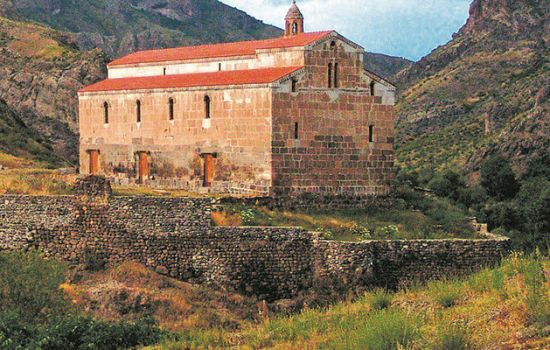 Aghoghlan monastery
The Amaras Monastery in Khojavend district is considered one of the oldest Christian centers in the region. Historical sources indicate the connection of this place with the Albanian church. However, as a result of Armenian interventions in later periods, cases of alteration of some inscriptions and reconstruction of the interior have been observed.
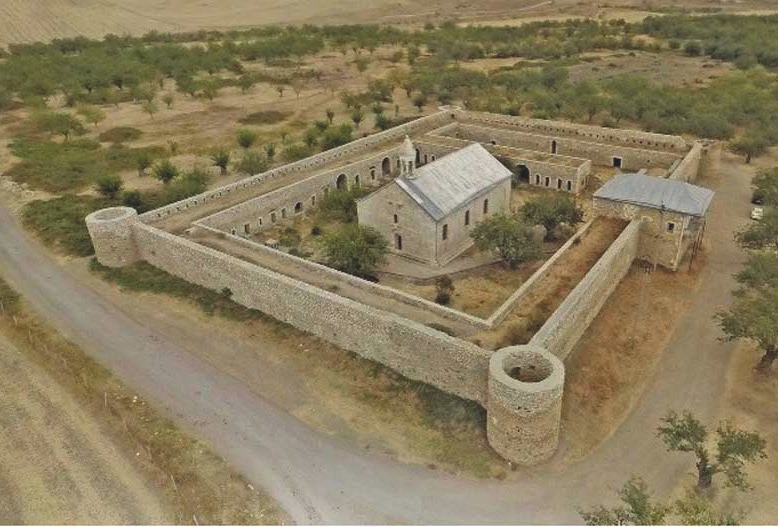 Amaras Monastery
The Khudavang Monastery located in the Kalbajar district is a large religious complex dating back to the Middle Ages. The inscriptions and architectural details on the monument are among the main elements indicating that it belongs to Albanian heritage. During the occupation period, it was revealed that some inscriptions in the monastery were altered and additional elements were introduced.
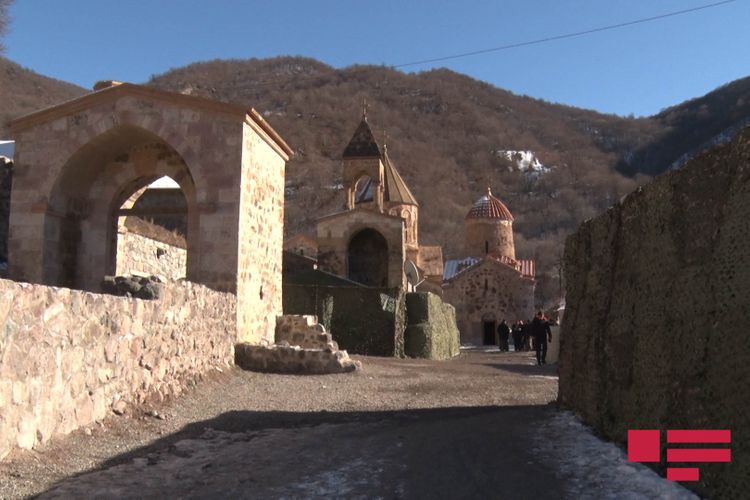 Khudavang Monastery
The Gandzasar monastery is also located in Kalbajar and is one of the well-known religious monuments of the region. The inscriptions and ornaments on it reflect different periods. However, in some cases, the interpretation of these elements has been altered by Armenians, and the origin of the monument has been presented in a different way.

Similar interventions have also been recorded at the Khatiravang Monastery. As a result of reconstruction works, partial changes to the original architectural features and the weakening of some historical traces have been observed. These facts show that the monuments have been subjected not only to physical, but also to historical identity transformation.
 Khatiravang Monastery
This approach is not only limited to the religious and architectural sphere, but is also an attempt to reconstruct the historical narrative. The aim has been to change the affiliation of the monuments and to create a “historical basis” for future political claims.
Cultural cleansing strategy – objectives and geopolitical consequence
All the facts mentioned above are united along one logical line: the policy implemented during the occupation period was a large-scale cultural cleansing strategy. The main objective of this strategy was to change the demographic and cultural structure of the territories, erase historical traces, and create artificial grounds to legitimize future political claims.
This process has implications not only at the regional level, but also within the system of international relations. Because such systematic attacks against cultural heritage raise issues regarding the effectiveness of international law, the functionality of monitoring mechanisms, and the response of global institutions.
Armenia cannot evade responsibility
 Aghdam Juma Mosque
A comprehensive analysis of the existing facts shows that the cultural destruction carried out during the occupation period was not accidental, but the result of a systematic policy. This policy, in addition to violating international law, has also posed a serious threat to long-term stability in the region.
The restoration process carried out today is not only the restoration of infrastructure, but also the restoration of historical justice.
The end of the occupation does not mean forgetting the acts of vandalism committed by Armenia against the religious, cultural, and historical monuments of the Azerbaijani people, nor does it absolve Armenia of responsibility. Yerevan should not forget that it bears responsibility for the atrocities committed over 30 years, for ecocide, culturicide, and for the irreparable damage inflicted on the religious beliefs and historical memory of the people. Both morally and legally…

