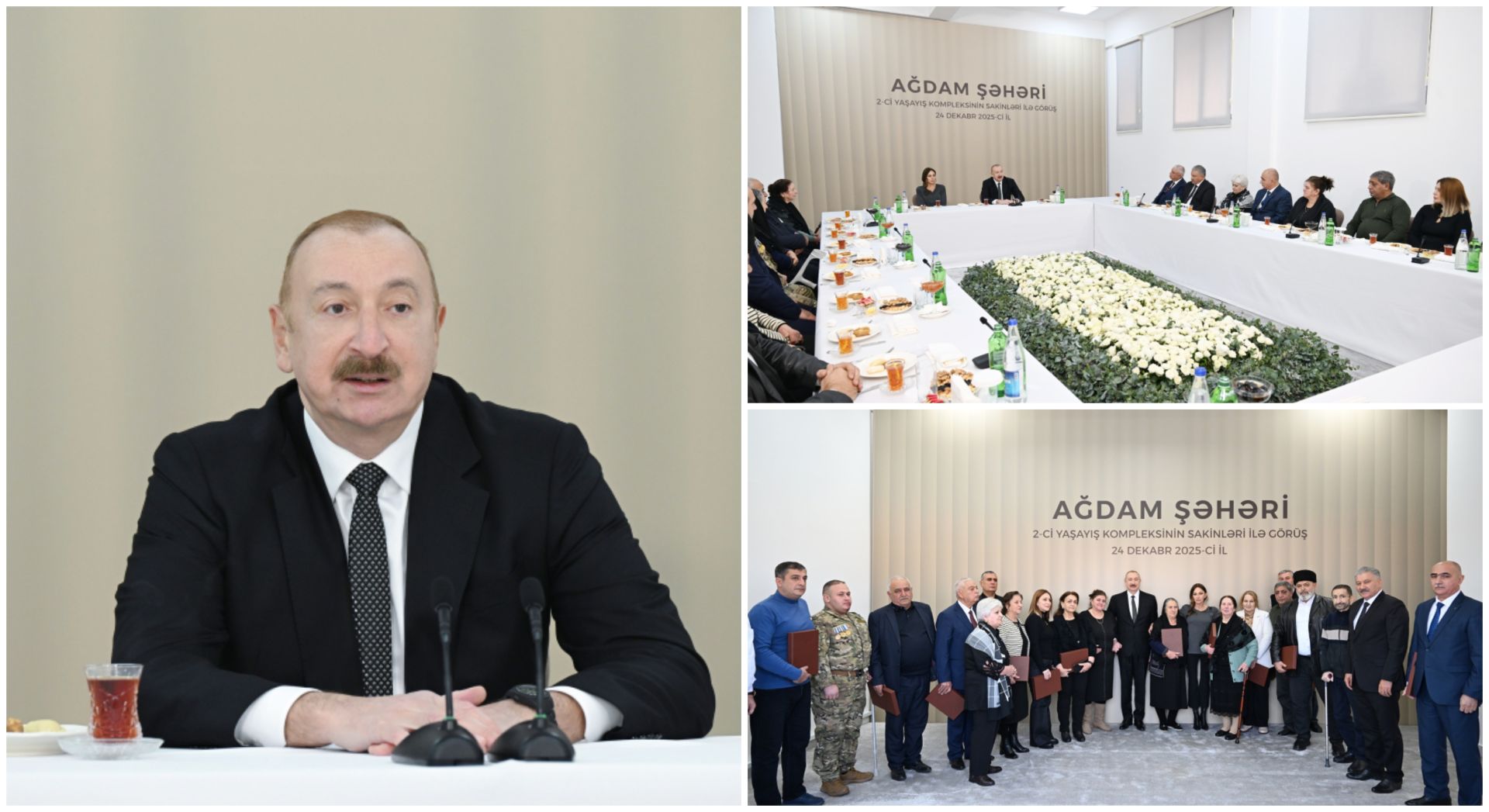
Aghdam today stands as a city where memory and reality intersect. Once reduced to ruins through years of occupation, it is now gradually re-emerging as a living urban space, shaped by return, reconstruction, and reflection. The reopening of residential neighbourhoods in the city is not merely a housing milestone; it is a reminder of what was deliberately destroyed, what was endured, and what is being rebuilt. In this setting, the broader questions of accountability, international conduct, historical justice, and the fragile path toward peace between Azerbaijan and Armenia come sharply into focus.
The opening of the second residential complex in Aghdam on December 24 was not only a milestone in the “Great Return” Program, but also a moment deliberately framed by President Ilham Aliyev as a historical reckoning. Speaking to returning residents, the President placed today’s reconstruction alongside the deeper political, moral, and strategic lessons drawn from occupation, war, and the post-war order. His speech, while rooted in Aghdam, addressed much more than one city; it articulated Azerbaijan’s interpretation of history, international behaviour, and the conditions for lasting peace.
President Ilham Aliyev described Aghdam as a stark illustration of Armenia’s occupation policy, stating clearly: “It is possible to say that Aghdam was subjected to urbicide during the years of occupation. In other words, the city was razed to the ground by the Armenian state. This was a clear example of a deliberate policy by Armenia and an expression of its hostility toward us.”
According to the President, the occupation was never accidental or limited to military control. Its objectives were systematic: looting, erasing Azerbaijani historical and cultural heritage, and making a return impossible. He underlined that buildings were dismantled stone by stone and sold elsewhere, while mosques and holy places were desecrated. Natural resources, forests, mineral deposits, and mines were plundered, and vast areas were mined to prevent future habitation, a threat that continues to claim Azerbaijani civilian lives even after liberation.
Evidence uncovered after the liberation of territories from 2020 onward reinforced this assessment. Cities and villages were found destroyed, buildings dismantled and transported to Armenia and other destinations, and cultural heritage deliberately erased. Mosques and holy places were desecrated, not as collateral damage, but as a symbolic insult. Alongside this, forests were cut down, mineral and gold deposits exploited, and other natural resources plundered.
The destruction uncovered after 2020, documented through footage and on-site inspections, reinforced this assessment. In the President’s words, the aim was clear: “A third goal was to render the city uninhabitable, so that Azerbaijanis could never think of returning. But they made a mistake.” The scale of rebuilding now underway, particularly in Aghdam, is presented as the clearest rebuttal to that policy.
Another dimension of this policy was mass mining. Large areas were deliberately contaminated with landmines to prevent the return of civilians, a practice that has continued to claim Azerbaijani lives even after the end of the occupation. The theses also draw attention to the activities of Western companies that operated illegally in the occupied territories, participated in the exploitation of Azerbaijan’s national wealth, and have faced no accountability to date.
A central theme of the speech was the role of international actors during the occupation period. President Aliyev openly criticized the institutions tasked with managing the Armenia-Azerbaijan conflict, noting: “The institutions dealing with the Armenia-Azerbaijan conflict, including those empowered by international organizations, held a different opinion. They were often in solidarity with Armenia, the occupying and plundering state.”
He singled out the OSCE Minsk Group as ineffective and biased, recalling nearly two decades of negotiations that, in his view, aimed not at ending occupation but at perpetuating it. “Instead of resolving the issue, the goal of the group and its co-chairs was to make the occupation permanent, justify Armenia, and coerce the Azerbaijani people and state into accepting it,” he said, adding that it often felt as though Armenia and the co-chairs sat on one side of the table, with Azerbaijan isolated on the other.
Military support to Armenia was described as another manifestation of this imbalance. President Aliyev reminded the audience that Armenia received large-scale weaponry despite its limited resources, including systems it should not have possessed at all. He posed a direct question: “How could the ‘Iskander M’ missile strike Shusha?” The weapons destroyed or seized by Azerbaijan during the war and the subsequent anti-terrorist operation, he noted, amounted to “approximately 5–6 billion dollars,” underscoring the scale of external assistance Armenia had received.
Political and economic backing followed the same pattern. Separatist leaders were able to travel, raise funds abroad, and operate offices in major countries, privileges denied to separatist entities elsewhere. “Can America, France, or European countries give visas to their leaders? No. But why did they give them to Armenian separatists?” the President asked, presenting this as further proof of double standards.
Victory, sovereignty, and the end of imposed narratives
Against this backdrop, the Second Garabagh War is framed not only as a military success but as the restoration of justice, dignity, and international law. President Aliyev emphasised that Armenia had no intention of withdrawing voluntarily: “The Armenian state did not intend to vacate an inch, a centimetre of our land… We forced them to do so.” Indeed, analysts and regional observers have noted that Armenia’s refusal to negotiate meaningful territorial compromise prior to 2020 contributed to the ultimate resort to force. The conflict, which had frozen for decades under the status quo maintained by the OSCE Minsk Group, erupted again when Azerbaijan launched a military operation in autumn 2020 to restore control over its internationally recognized territories. The military outcome of that conflict resulted in Azerbaijan regaining control over all occupied districts surrounding Garabagh as defined under international law, reversing the territorial losses dating back to the early 1990s.
President Aliyev also stressed that Azerbaijan’s unity and resilience made victory possible despite pressure and threats during the war. “The people of Azerbaijan united like a fist,” he said, crediting the Armed Forces and the sacrifice of martyrs. This unity was critical not only on the battlefield but in sustaining domestic solidarity in the face of intense geopolitical pressures. Observers have noted that Azerbaijan’s domestic consensus around territorial integrity and its readiness to act when diplomacy stalled was decisive factor in its ability to regain full control, including over Garabagh by 2023, leading to the displacement of most of its ethnic Armenian population and effectively ending the military phase of the conflict.
He also linked this wartime success to subsequent political consolidation. The anti-terrorist operation of 2023 is described domestically as a follow-on action that secured that victory politically and territorially, closing what he called “the book of separatism.” Indeed, after the 2020 conflict, repeated tensions and unresolved status issues persisted until Azerbaijan’s operations in 2023 led to the full restoration of control over the territory, effectively eliminating the de facto separatist administration that had existed for decades.
A key international consequence cited in the speech was the dissolution of the OSCE Minsk Group, a mediation mechanism established in 1992 to manage the Armenia-Azerbaijan conflict. “The fact that the loathsome Minsk Group has been consigned to the archives of history was also achieved as a result of our persistent efforts,” the President stated, adding that no force could stand in the way of Azerbaijan’s will. This was not mere rhetoric: in 2025, the OSCE Ministerial Council formally decided to terminate the Minsk Process and close all institutions associated with it, following a joint appeal by Azerbaijan and Armenia.
This formally ended a negotiation track that had operated for more than three decades but had not resolved the fundamental dispute over territory.
While sovereignty has been restored, President Aliyev warned that anti-Azerbaijani activity continues in new forms. He pointed to lobbying campaigns, the portrayal of individuals on trial in Baku as prisoners of war, and claims about forced deportation of Armenians who left Azerbaijani territories voluntarily. He described these narratives as “a distortion of facts and an integral part of Yerevan’s games against Azerbaijan.”
He also criticized the role of certain Western figures and mechanisms, including the continued presence of the European Union military mission in Armenia, characterizing it as a continuation of the “binocular policy.” In his assessment, such actions risk undermining a peace process that Azerbaijan itself initiated and authored.
Memory as a condition for peace
Despite ongoing negotiations and normalization efforts, the President was unequivocal that peace cannot be built on amnesia. “How can we ever forget the occupation? How can we ever forget our martyrs? How can we ever forget the Khojaly victims?” he asked. Historical memory, he argued, must be preserved across generations, in schools, universities, and families, not to fuel conflict, but to ensure vigilance and resilience.
This insistence on memory reflects a broader societal process in Azerbaijan in the aftermath of decades of war and displacement. For many Azerbaijani families, the legacy of occupation is not a distant chapter but a lived reality: entire populations were displaced, homes were lost, and communities were reshaped. The Khojaly tragedy of 1992 remains one of the most painful reminders of this era, and it continues to shape popular perceptions of peace and justice in the region. Preserving this memory is therefore seen not simply as commemoration, but as anchoring future policies in an awareness of past injustices, ensuring that peace does not become oblivion but remains informed by the lived experience of suffering and resilience. This concept of historical memory as a foundation for future vigilance is echoed in Azerbaijani public discourse and policy, where education and cultural narratives increasingly emphasise remembrance alongside reconciliation.
This philosophy extends to policy as well. Azerbaijan, he said, must always remain stronger than any potential threat: “In order to achieve eternal peace, we must always be several times stronger than our potential enemies.” Strength, in this sense, is presented as a guarantor of stability, not an obstacle to reconciliation. In international relations, this belief mirrors broader strategic thinking: states that emerge from protracted conflict often seek to consolidate military and institutional capacities as safeguards against future aggression. In the South Caucasus context, where distrust persists and the memory of broken ceasefires and frozen processes remains fresh, capability is viewed as a deterrent that supports peace rather than undermining it.
Finally, President Aliyev highlighted contradictions that persist even as talks advance. While communications are discussed, trade relations explored, and the so-called blockade is absent, punitive measures against Azerbaijan remain. One prominent example he cited is the continued existence of the “907th Amendment” to the US “Freedom Support Act,” despite its temporary suspension. The amendment originally barred direct U.S. government assistance to Azerbaijan until Baku ended what was defined as a blockade, a legal restriction that effectively made Azerbaijan the only post-Soviet state excluded from direct U.S. aid in the early 1990s.
Though the executive branch of the U.S. has routinely waived Section 907 in recognition of broader cooperation, especially through counterterrorism and regional security work, the measure itself has often been criticised in Azerbaijan as a symbolic relic of bias and double standards. Critics argue that Section 907 was shaped more by the influence of interest groups and historical narratives in the U.S. Congress than by an evenhanded assessment of the conflict’s dynamics, a point underscored by the fact that Armenia received direct aid while Azerbaijan did not under this provision.
Even in recent years, efforts by some U.S. lawmakers to reinforce or revive elements related to Section 907 demonstrate that, in the view of Azerbaijani officials, old narratives still influence policy debates abroad. This persistence can complicate normalisation by maintaining legislative language that many in Baku see as rooted in outdated assumptions about the conflict rather than the present realities of reconciliation and cooperation. Critics suggest that truly comprehensive normalisation would involve moving beyond such measures, which are perceived as impediments to strategic partnership and as vestiges of a historical bias in external policymaking.
In the President’s framing, genuine normalisation requires the removal of these relics of bias. For Azerbaijan, this is about aligning legal frameworks with the current landscape of peace talks, economic cooperation, and mutual recognition, rather than allowing old constructs to shape new realities. Only by addressing both the historical grievances embedded in collective memory and the structural inconsistencies that remain in external policies, he argues, can a durable and equitable peace be constructed in the South Caucasus.
The transformation of Aghdam, from a symbol of destruction to a city of return, anchors these broader arguments in tangible reality. Residential neighbourhoods, industrial zones, railways, cultural sites, and educational institutions now stand where ruins once lay. As President Aliyev noted, all of this was achieved in a short period because of collective determination: “It shows that all our people are doing this work with tremendous enthusiasm.”
In this sense, Aghdam is more than a rebuilt city. It is presented as evidence that history, once denied, has been reclaimed, and as a reminder that peace, to be lasting, must rest on truth, justice, and an unforgotten past.

