Every industry has its stories, but few are as visually striking or as personally transformative as the world of oil.
For Nigar Manafli, years spent on offshore platforms were a source of memory, rhythm, and unexpected beauty. The shapes of machinery, the movement of workers, and the interplay of light and shadow on steel became imprinted in her mind, waiting to be translated into art.
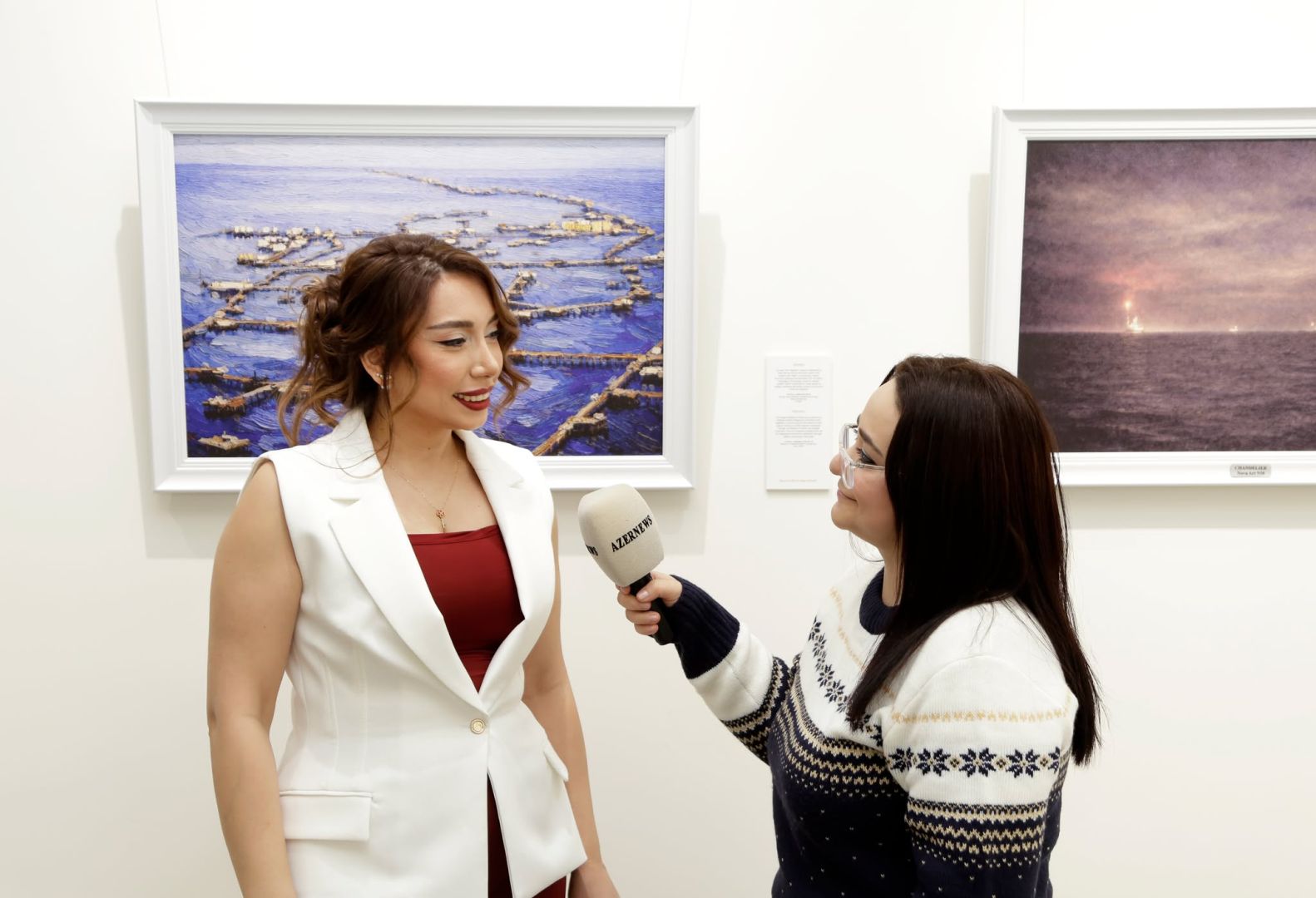
This intimate perspective forms the heart of "The Heritage of Oil", Nigar Manafli's solo exhibition, recently opened at Baku's D'Art Gallery.
Nigar Manafli graduated in 2013 from the Azerbaijan State University of Oil and Industry with a degree in Geological Exploration. That same year, she began her professional career as one of the first Azerbaijani women well-logging specialists, working in geophysical well surveys on offshore platforms.
For seven years, the engineer-geologist worked directly on offshore platforms, participating in high-risk field operations that demanded exceptional responsibility and technical expertise under real oil production conditions.
In 2023, she was appointed Maintenance Superintendent at Central Azeri, becoming the first woman to hold this position.
In an interview with AZERNEWS, the artist shares how years spent working in the oil industry became the foundation for an unexpected artistic journey.
Drawing inspiration from one of Azerbaijan's most vital and demanding sectors, her exhibition "The Heritage of Oil" pays tribute to the people behind the industry, those whose daily work combines technical precision, responsibility, and resilience.
The project features 29 artworks that reveal the hidden aspects of offshore life: the scale of operations, the rhythm of metal structures, silent responsibility alongside high risk, the power of storms, the quiet of night shifts, and the unspoken dialogue between humans and the sea.
"The Heritage of Oil" combines technical knowledge with personal memory, translating industrial heritage into a contemporary visual language and inviting viewers to reflect on the boundaries between technology and human experience.
The project represents one of the first public presentations of AI-based art in Azerbaijan, reinterpreting the country's rich oil history through a personal and artistic lens.
Q: How did the idea for an exhibition inspired by the oil industry come about?
A: The idea grew out of my many years of experience working in the oil industry, directly on offshore drilling platforms. In essence, this project is a visualization of my personal memory. I spent many years working on the Azeri-Chirag-Gunashli oil field, carrying out highly complex technical operations.
My work involved radioactive sources, irradiated materials, and high-pressure equipment, and I was responsible for supervising these processes. It is an extremely demanding and high-responsibility field, yet over time, I began to perceive a certain kind of beauty within this industry.
I felt a strong desire to capture fragments of my memories on canvas, transforming them into paintings. Today, the possibilities offered by artificial intelligence made this achievable. I used a digital art program for this purpose, as creativity has always been very important to me.
Unfortunately, our profession leaves very little free time, and traditional painting is a long and complex process. However, visualization is possible. I am genuinely happy that when my colleagues from the oil industry look at these works, they recognize themselves in them. One colleague recently said to me, "I see myself in these paintings."
I believe that every oil worker can see a part of themselves in these works. In that sense, I feel my mission has been fulfilled, because creating precisely this kind of personified collection was my original intention.
Q: How do you see the role of artificial intelligence in contemporary art?
A: In this context, artificial intelligence is simply a tool. You tell it what you want to see in the final result. It does not dictate ideas, nor can it independently know what needs to be depicted.
The idea belongs entirely to the human being. Artificial intelligence is merely a means through which that idea can be realized, presented, and preserved as a form of memory.
Q: What projects are you planning to pursue in the near future?
A: To be honest, this project began as something deeply personal. I created several artworks for myself and displayed them in my office. My colleagues showed great interest, and over time, I began to expand the collection.
Last month, the management asked me to present my work at our staff party. At that time, the exhibition included only a small number of pieces. I brought them along and witnessed a strong response not only from colleagues, but also from their family members.
The event brought together people from very different professional backgrounds: for example, a husband working in the oil industry and a wife from a completely different field. Even they felt an emotional connection to the artworks. That moment sparked the idea of involving more oil workers and sharing this project with a wider audience.
These works speak volumes. And that is precisely why I decided to create a full-scale exhibition.
----
Photo Credits: Rustam Gasimov

